Participant information
Dear participant,
we hereby invite you to participate in the Eating and Nutritional Habits in Athletes and Controls - a longitudinal Examination (ENHANCE). Please read the following information carefully. You can then decide whether you would like to agree to participate in the study. Please take your time and ask questions if anything is unclear to you. This study is planned, conducted and analysed by the Clinic for Psychosomatic Medicine and Psychotherapy, LVR University Hospital Essen. The study team consists of staff working at the institution.
You can download the full version of the participant information here: Participant Information
1. Objective of the study:
Elite sport expects you to follow strict training schedules, a certain body image and specific eating and nutritional habits in order to have the energy you need to reach your full athletic potential. The exact mechanisms of how your energy levels lead to top athletic performance or to psychological symptoms, such as mood swings, are still unclear. The ENHANCE-study examines the sport-specific eating and nutritional habits of elite athletes in ballet, bodybuilding, tennis, soccer and basketball in comparison to the general population (control group). We want to find out to what extent elite sport influences eating and nutritional behaviour and how eating in turn affects the sports performance and mood. In the long term, we want to determine the protective and risky mechanisms that affect eating behaviour in elite sport.
2. Study procedure:
All participants get informed about the study procedure and the data protection regulations in the online survey before participation at the first assessment point. After your digital declaration of informed consent, participation criteria will be queried. Based on your answers you will be assigned to either the Elite Athletes Group or the Control Group. The correct classification into the study groups is important to achieve meaningful study results.
You are assigned to the Elite Athletes Group, if you:
- organize your everyday life around your sport,
- regularly take part in competitions or performances,
- train a minimum of 300 minutes a week with at least moderate intensity
- for at least 6 months
In our study, we specify on elite athletes from professional:
- ballet,
- bodybuilding,
- tennis,
- soccer
- and basketball
This specification enables sufficient large samples per sport disciplines to investigate differences between the sport disciplines.
If you meet the above criteria and you practice one of the sports disciplines, we investigate; you are assigned to the Elite Athlete Group.
Please skip to section 2.1. There you will find all the relevant information you need to know for your participation in the Elite Athlete Group.
If you meet the above criteria, but you do not practice one of the sport-disciplines we investigate, unfortunately study participation is not possible for you. We thank you for your interest in our study.
If you do not meet the criteria of the Elite Athletes Group, you are assigned to the Control Group. Participants from the Control Group can also exercise regularly, but with lower training load, intensity and professionalism. Then you can skip to section 2.2. All relevant information that you should know for your participation in the Control Group is described there.
No subject or travel insurance has been taken out for this study.
2.1. Study procedure for Elite Athletes
As an athlete, you will take part in an online survey as a baseline assessment and 3 follow-up assessments online. In addition to your participation in the online-surveys you will be invited for an interview and body measurements.
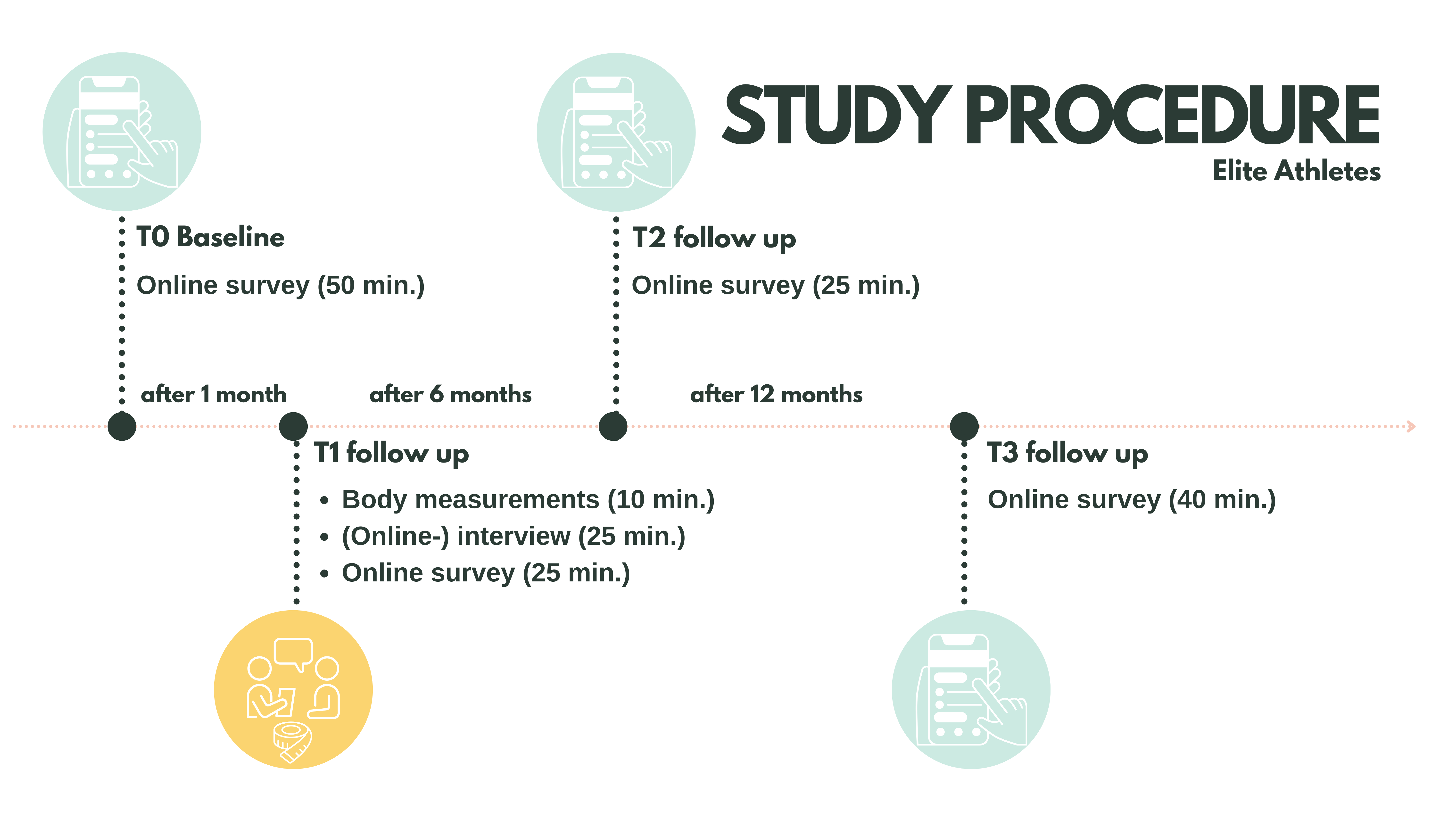
After the first and third follow-up assessments you can claim your expense allowances. Further details you will find below.
2.2. Study procedure for the Control Group
As a control, you will take part in an online-survey as a baseline assessment and 3 follow-up assessments.
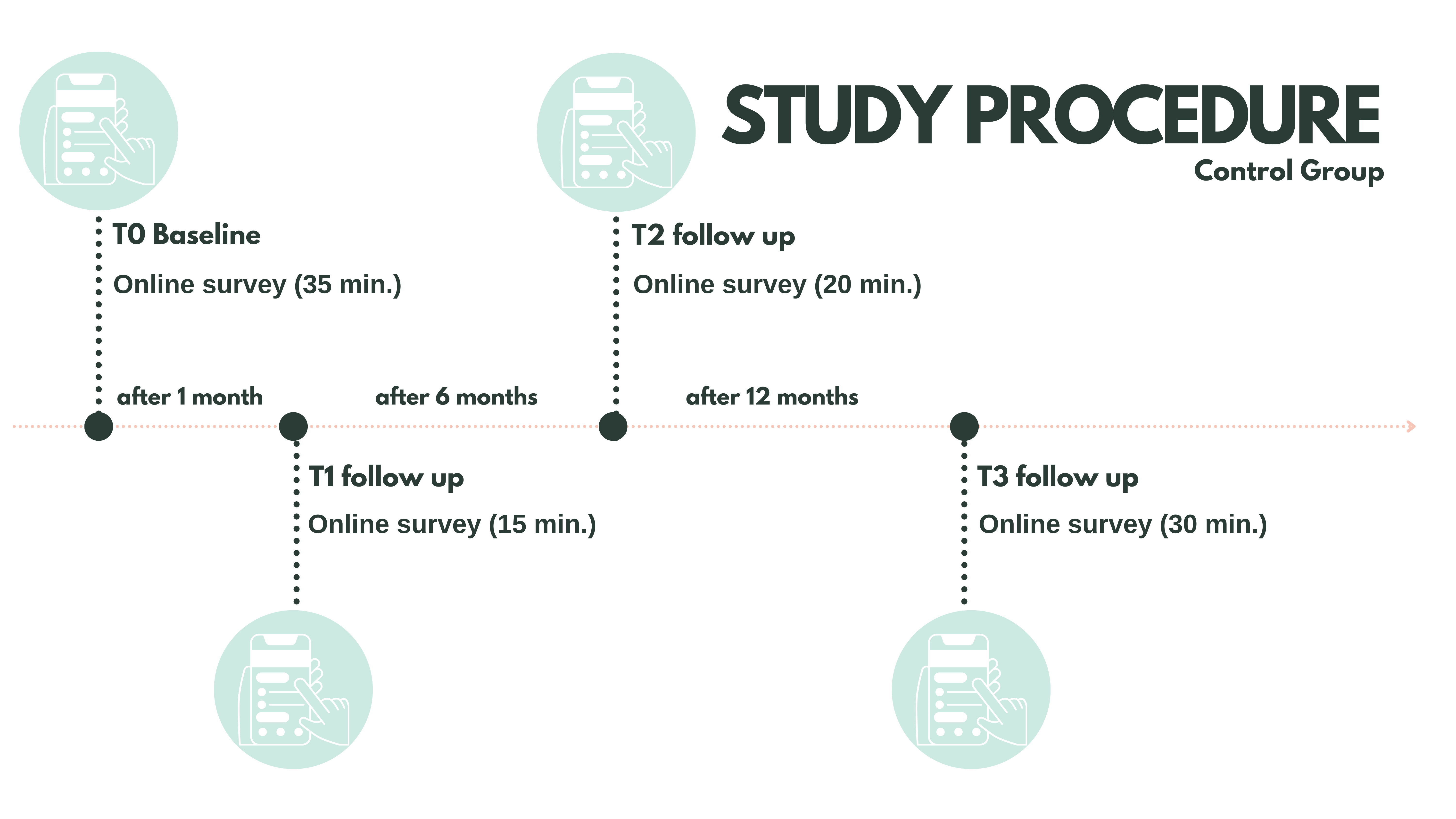
After the first and third follow-up assessments you can claim your expense allowances. Further details you will find below.
3. Risks:
No subject or travel insurance has been taken out for this study. Participation in this study is voluntary. You can cancel your participation in the study at any time and without giving reasons, without incurring any disadvantages or obligations. If you withdraw from the study, you can decide at any time whether the data already provided should be destroyed or may be used for scientific purposes.
4. Benefits:
For you as a participant, the study offers the opportunity to make an important contribution to clinical research and to actively shape the development of future treatment programmes and diagnostic tools in a needs-oriented manner. This will enable many elite athletes to benefit from the support programs in the future.
5. Information on data privacy:
5.1. Which data will be collected?
In the online-surveys, elite athletes and controls are asked about sociodemographic data (e.g. age, sex), health information (e.g. injuries, menstrual function, weight, height), and psychological data (e.g. eating-, nutritional- and training behaviour, fatigue and mood) at 4 different measurement points with set time intervals. For elite athletes, additional sport-specific information (e.g. training load) is collected, diagnostic interviews are conducted and body-related data are measured.
5.2. How will the data be collected, stored, analysed and published?
5.2.1. Information for athletes (controls can jump to section 5.2.2.)
The diagnostic interviews and measurement of body-related data are conducted, documented and stored psyeudonymised (see section 5.2.2.) by trained specialists of the study team in an Electronic Case Report Form (CRF, a separate survey-link) in accordance with the clinic's standard operating procedure. If the interview is conducted online, participants will receive a link to a protected video-conference room. Optionally the body-related data can be measured by an external expert chosen by the participant. The body-related data can be transmitted to the study team via the CRF, which will be provided for the participant by the study team via email. Only the study team has access to the entered data in the CRF.
5.2.2. General data processing
When you take part in the online survey at the basline assessment assessment, you can enter your e-mail address and telephone number, which will be stored separately from your survey data. Your data will be collected, stored and analysed pseudonymised. Pseudonymisation means the replacement of the name and other identification features with an identifier (e.g. meaningless number code) for the purpose of excluding or significantly complicating the identification of the person or the participant. For this purpose, you will generate your individual participation code the first time you take part in the online survey and enter the code at all assessment points. This code will be used to link the data from the different online surveys you completed, without the data being able to be traced back to you personally.
A list for decrypting the pseudonyms is created. This means that your participation code will be stored together with your e-mail address and telephone number, the date of your participation, your sex, your age, and your group assignment criteria in a password-protected list that is only accessible to the study team. If you are an athlete, the list will also entail the sport discipline you practice and the date of your interview/body measurement appointment. This list will be stored separate from survey-, interview- and body-related data and will be deleted after the study is completed. If your e-mail address contains your name personal identification is possible. Study staff having access to the e-mail address is obliged to maintain confidentiality. You can use an e-mail address which does not entail your name.
The survey-, interview- and body-related data will be stored pseudonymised for ten years after completion of the study in digital form in a password-protected database. For scientific publication data will be anonymised. In this study, the Clinic for Psychosomatic Medicine and Psychotherapy, LVR University Hospital Essen is responsible for data processing. The legal basis for the processing is personal consent (Art. 6 para. 1 lit. a, Art. 9 para. 2 lit. a GDPR). The data will be treated confidentially at all times. The data will be collected exclusively for the purpose of this study described above and will only be used within this framework. The study data will not be accessible to third parties. You have the right to obtain information about your personal data and it’s processing and to have it corrected in the event of an error. Further details on the use of your data, security measures to protect the confidentiality of your data and how to obtain copies can be asked from the study team (contact: enhance@uni-due.de).
If you have any questions about data processing and compliance with data protection, please contact the data protection officer:
Data Protection Officer of the LVR (Landschaftsverband Rheinland)
Hermann-Pünder-Straße 1, 50679 Cologne
Tel 0221 809-2550 datenschutzbeauftragter@lvr.de
You also have the right to lodge a complaint with any data protection supervisory authority. You can find a list of the supervisory authorities in Germany at: https://www.bfdi.bund.de/DE/Infothek/Anschriften_Links/anschriften_links-node.html
You can contact the supervisory authority responsible for you at
State Commissioner for Data Protection and Freedom of Information North Rhine-WestphaliaPostfach 20 04 44
40102 Düsseldorf
Tel.: 0211 - 38424 - 0
E-Mail: poststelle@ldi.nrw.de
Voluntary participation:
Your participation in this study is voluntary. If you wish to participate, we ask you to declare your digital consent. You can withdraw your consent to participate at any time without giving reasons and without any disadvantages for you. If you withdraw your consent, you can decide whether the data collected from you for the study should be deleted or whether it may continue to be used for the purposes of the study. Even if you initially consent to further use, you can change your mind at a later date and request the deletion of the data or object the processing of your data and the data transfer. Please note that data that has already been included in scientific evaluations or data that has already been anonymised can no longer be deleted or excluded from processing at your request.
Please address your cancellation to:
Anna Esser-Seraphin, M.Sc. Psychologist
E-Mail: enhance@uni-due.de
Phone: 0201 438755 214
Costs/expense allowance:
Participation in the study is free of charge for you. An expense allowance will be paid as a compensation for filling out the surveys that have been completed in full (excluding the questions that the participants do not wish to answer), the interview and the body measurements as follows:
Baseline and first follow-up online surveys
(T0 & T1)
Athletes 25,00 €
Controls 14,00 €
Second and third follow-up online surveys
(T2 & T3)
Athletes 18,00€
Controls 14,00€
Interview (T1)
Athletes 10,00€
Body measurement (T1)
Athletes 5,00€
In case of different money currencies, the amount might be different.
To apply for the expense allowance, you can enter your bank details, your name, address, e-mail and your participation code in a separate link after the first and third follow-up assess-ment. A corresponding link will be available after the interview or/and body measurement has been carried out.
The participation code is used to check whether you have taken part in the study and whether the surveys have been completed in full. This data is stored in a password-protected folder that is only accessible to the study team and is kept separate from the study data. Your account data will be deleted after the study has been completed.
It is not possible to apply for an expense allowance for participation in a single assessment. Payment can only be made if you provide your bank details, e-mail address and participation code correctly. You can waive the expense allowance. These funds will be returned for further research purposes.
Contact person for questions:
Anna Esser-Seraphin, M.Sc. Psychologist
Clinic for Psychosomatic Medicine and Psychotherapy,
LVR University Hospital Essen Clinics and Institute of the University of Duisburg-Essen
Virchowstr. 174, 45147 Essen
E-Mail: enhance@uni-due.de
Tel.: 0201 438755 214
Coorperation partner:
Prof. Georgios Paslakis
University Clinic for Psychosomatic Medicine and Psychotherapy,
Medicine Campus OWL,
Ruhr-University Bochum, Lübbecke,
North Rhine-Westphalia, Deutschland
